The Rosette Nebula is a vast emission nebula located approximately 5,200 light-years away in the constellation of Monoceros, the Unicorn. This spectacular star-forming region lies near a giant molecular cloud and is closely associated with the young open star cluster NGC 2244.



Rosette Nebula
Check out our work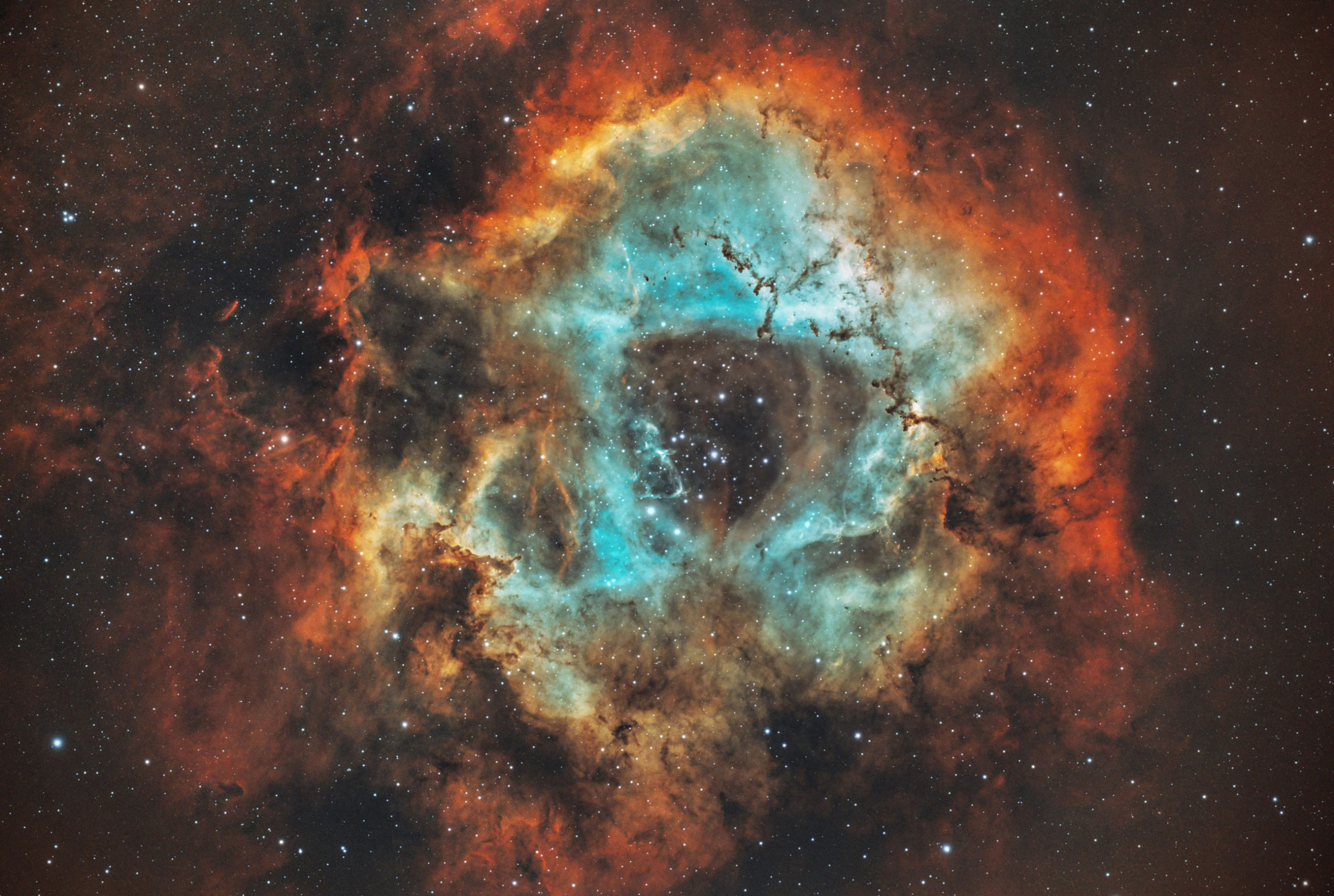
The Rosette Nebula
(cataloged as NGC 2237, NGC 2238, NGC 2239, NGC 2246, and Caldwell 49)
Also known as the Satellite Cluster, NGC 2244 lies at the heart of the Rosette Nebula. Its hot, young stars formed from the surrounding nebular material within the past five million years.
These massive, energetic stars illuminate the Rosette Nebula, producing its characteristic glow. Their intense ultraviolet radiation ionizes the surrounding hydrogen gas, causing it to emit light. The nebula’s distinctive red glow comes primarily from hydrogen atoms releasing energy as their electrons recombine with protons, producing the characteristic red emission known as hydrogen-alpha (Hα).
Active star-forming region
The Rosette Nebula is a highly active stellar nursery, hosting a diverse range of young stellar objects and star-forming structures. These include Herbig–Haro objects, Herbig Ae/Be stars, Bok globules, T Tauri stars, and clusters of newly formed stars.The dark, elongated filaments of dust and gas extending toward the nebula’s centre are sometimes referred to as “elephant trunks.” These structures are sculpted primarily by the intense stellar winds and radiation from hot, young stars, which erode and compress the surrounding material, shaping the nebula’s intricate landscape.
The Rosette Nebula, also known as the Rosetta Nebula, spans approximately 130 light-years across and covers an angular diameter of about 1.3 degrees in the night sky. It is considerably larger than the better-known Orion Nebula, which measures around 24 light-years across. However, because the Orion Nebula is much closer to Earth, at approximately 1,344 light-years away, it appears brighter despite its smaller physical size.
With an estimated mass of around 10,000 solar masses, the Rosette Nebula is home to approximately 2,500 stars. Its most massive O- and B-type stars emit intense radiation and powerful stellar winds that illuminate the surrounding gas and drive the nebula’s expansion.
Over the next few million years, these forces will gradually disperse the nebula’s remaining gas and dust, leaving behind the central open star cluster NGC 2244 as a lasting remnant of this stellar nursery.
Rosette Nebula